
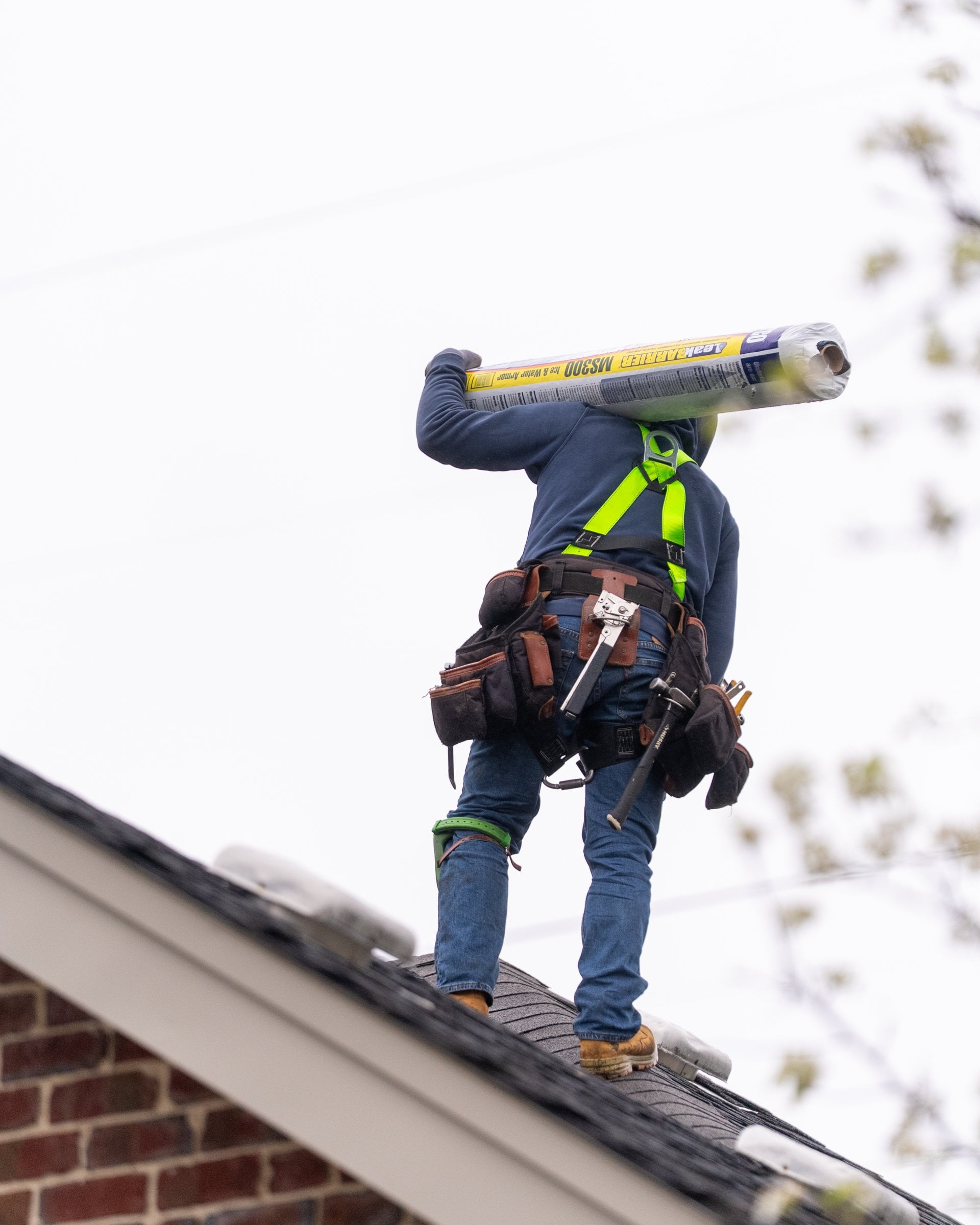
Who wants to talk about underlayment? I do. And whether you know it yet or not, you do too — because it’s the line item on your estimate that almost nobody asks about, and it makes a real difference in how your roof performs.
When you get an estimate for a roof replacement, you should see some verbiage on there about underlayment. Synthetic underlayment. 15-lb felt. Something. But what does that actually mean? What is it, and what are they putting on your house?
Let’s go through it.
What underlayment is and where it goes
Underlayment is what goes down on your roof deck before the shingles — everywhere you’re not using ice and water shield. It’s the layer between the wood and the shingles, and it’s the thing still standing between your house and the weather if water ever gets past the surface.
You’ll never see it again after installation day. Which is exactly why it’s worth asking about before installation day.
Felt: the old standard
Back in the day — maybe 15 or 20 years ago — felt was what everybody installed. Some companies still do.
This is asphalt-based felt underlayment. Tar paper, as most people call it. And I want to be clear: I’m not knocking felt. It’s still a good product. There are some projects where we still use it, and if a customer requests it, we’ll install it. It’s the cheapest option because it’s the cheapest one to make.
The con is that it tears very easily.
We pull off 20-plus-year-old tar paper all the time, and by then it’s a lot more brittle than it was the day it went down — holes, tears, the whole thing. But the bigger issue is during installation. Felt can rip while you’re putting it on, and depending on how it happens, you may or may not notice. A lot of people just don’t feel as comfortable knowing the layer under their shingles is a paper that tears that easily.
It’s not our preferred product. But it’s available on request.
Synthetic: what most contractors install now
Nowadays most contractors, us included, install synthetic underlayment.
If you ever get to feel a piece of it, it’s like house wrap — it’s got that vapor barrier kind of feel to it. It takes a lot more effort to tear, and when it finally does tear, it opens up the way house wrap does rather than shredding. It’s a lot more durable, and I feel much better about that being on somebody’s house.
But here’s the part I really wanted to get to, because this is where people get surprised: not all synthetic underlayment is made the same.
The catch nobody mentions: breathability
Synthetic underlayment by default is not permeable. Or it’s got a very, very low perm rating.
What that means in plain terms is it doesn’t breathe. It doesn’t let vapor escape. It seals your roof deck up nice and tight.
Now — that’s a good thing if your attic ventilation is working properly. Sealed deck, ventilation moving air the way it should, everybody’s happy.
But if you’ve got moisture or condensation issues up there, you’re going to choke up your roof. You’ve just put a lid on it.
This is exactly why we ask the questions we ask before we start. How’s your attic ventilation? Do you have any condensation issues? We’re not asking to pad the estimate. We’re asking because we’re about to shut that roof deck tight, and we need to know what we’re sealing in.
That’s also why we stray away from the entry-level underlayments. Every manufacturer makes one, and they’re all more or less the same product.
What we prefer to install
What we actually put on houses is the heavier stuff. On a recent project that meant GAF’s Tiger Paw — every manufacturer has their own version of this, so it’s the category that matters more than the brand name.
Here’s the difference:
It’s much thicker. You can feel it immediately next to a basic synthetic. It’s a noticeably heavier material.
It’s got a much higher perm rating. Roughly four to five times more breathable than basic synthetic underlayment. So you get the durability of a synthetic without completely sealing off the deck.
It’s still very hard to tear. I can’t get this one to tear by hand, and I’m not exactly a strong guy.
It’s safer to walk on. Honestly, all synthetic underlayments are pretty safe to walk on. But there’s a difference in how this one feels underfoot, and my crews are up there all day.
It does cost more, and it does add to the material cost of the job. But we’re talking about a couple hundred bucks for a product that breathes better and works better on your home. That math has never been hard for me.
Frequently Asked Questions
What’s the difference between felt and synthetic underlayment?
Felt is asphalt-based tar paper — cheaper, and it tears easily, both after years on the roof and sometimes during installation. Synthetic is more like house wrap: much harder to tear and more durable overall. Most contractors have moved to synthetic, though felt is still a usable product and we’ll install it on request.
Is more expensive underlayment actually worth it?
The upgrade from an entry-level synthetic to a premium one is usually a couple hundred dollars on the total material cost. What you get is a thicker material and a much higher perm rating, which matters a lot if there’s any moisture happening in your attic.
What is a perm rating and why should I care?
It’s a measure of how much water vapor can pass through the material. Low perm means the underlayment seals your roof deck up tight. That’s fine when your attic ventilation is working. If it isn’t, sealing everything up can trap moisture in the roof system.
Why does my roofer keep asking about my attic?
Because underlayment choice and ventilation are connected. Before we seal a roof deck up with synthetic, we want to know whether your attic is ventilating properly and whether you’ve had condensation problems. Those answers change what we recommend.
Can I choose which underlayment goes on my roof?
You should be able to. Ask what’s specified on your estimate and, if it just says “synthetic underlayment,” ask which one. There’s a real difference between the entry-level products and the premium ones, and it should be a conversation, not a default.
Ask what’s going under your shingles
If you’ve got an estimate in hand right now, go look at it. Find the underlayment line. If it doesn’t say what product it is, that’s a fair question to ask whoever wrote it.
And if you want somebody to look at your roof, your attic ventilation, and tell you straight what belongs on your house — that’s what we do.
Contact us to schedule a free inspection.
